Data
LLM API pricing statistics 2026: what 335 models cost per million tokens
Checked n = 335 CSV CC BY 4.0
The median paid LLM API costs $0.40 per million input tokens and $1.88 per million output tokens. That is the middle of 335 paid models from 54 providers listed in OpenRouter's public catalog on 2026-11-02, each at its standard price. Half of all models cost between $0.15 and $1.49 on input, and a typical request of 1,000 tokens in and 500 out costs a median $1.40 per 1,000 requests.
These LLM pricing statistics describe the whole market rather than a shortlist: the distribution of prices, how much more output costs than input, how open-weight and closed models differ, what caching and batch tiers take off, and how price tracks context window and provider. Every figure carries its n. If you want the current list price of a specific frontier model with its source, use the companion dataset, AI model API pricing for 19 models.
Key findings
- 223 of 335 models (67%) cost under 1 dollar per million input tokens. Only 12 (4%) cost 10 dollars or more, all from OpenAI and Anthropic, half of them OpenAI's Pro tiers.
- Output costs 4x input at the median. 50 models price output at exactly 4x input and 49 at exactly 5x; 133 (40%) charge 5x or more.
- Closed models cost about 5.6x as much as open-weight models at the median blended price ($1.98 against $0.35 per million tokens, n = 184 and 151).
- 68% of models offer cached input, usually at a tenth of the input price. The median cached read is 12% of input (n = 229); batch tiers, where listed, are a median 50% off (n = 68).
- Bigger context windows cost more. Models with more than 1M tokens of context have a median blended price of $3.00, against $0.43 for 32K to 128K models.
- Newer listings are not cheaper. Models listed before 2025 have a median blended price of $0.44; those listed in 2026 H2 $0.88, with the peak in 2026 H1 at $1.05. Price per token falls for a given capability, but new models mostly buy more capability at a similar price.
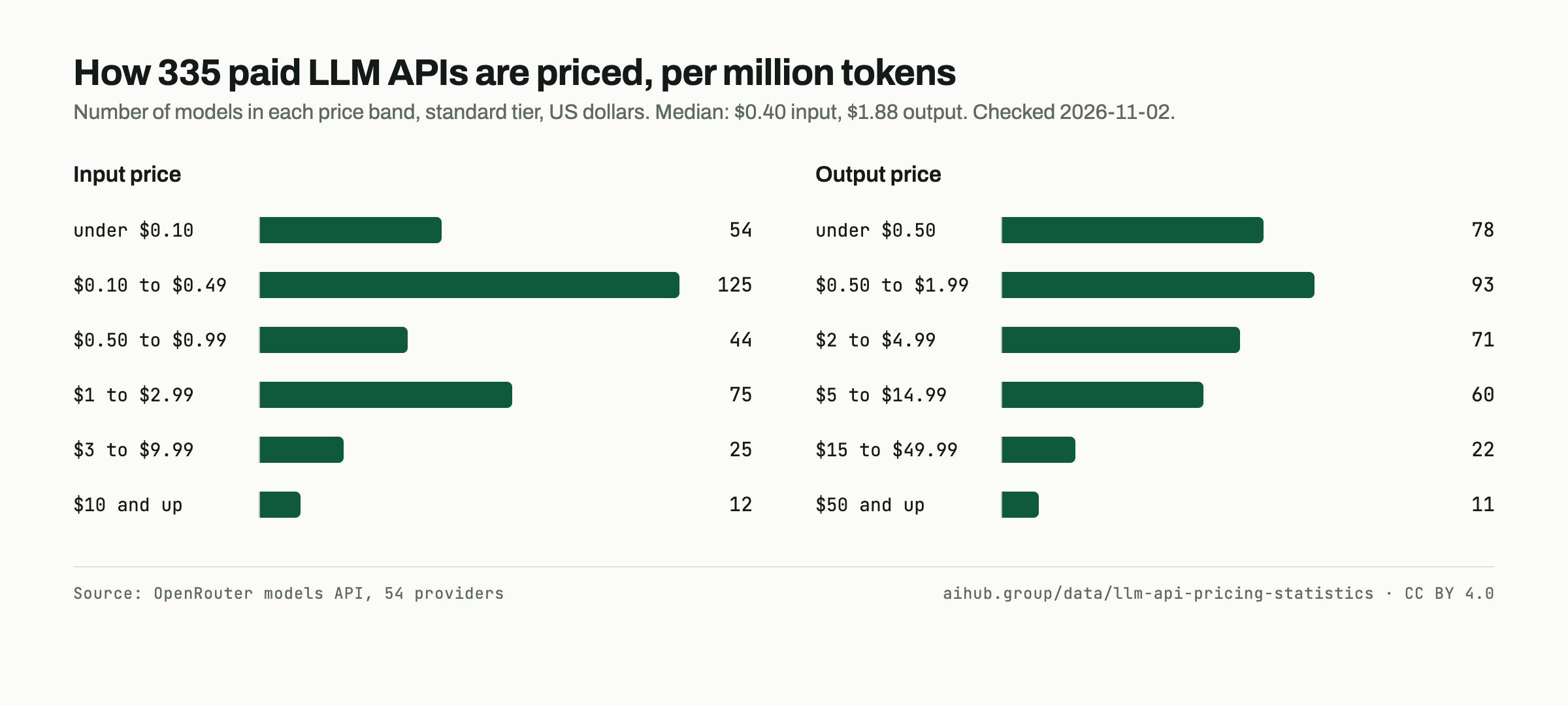
The price distribution
LLM prices are heavily skewed, so the median and percentiles describe the market far better than an average. The blended column weights input and output 3 to 1, the usual shorthand for a chat workload where prompts are longer than answers.
| Percentile (n = 335) | Input | Output | Blended 3:1 |
|---|---|---|---|
| Cheapest | $0.006 | $0.03 | $0.029 |
| 10th | $0.07 | $0.20 | $0.12 |
| 25th | $0.15 | $0.50 | $0.26 |
| Median | $0.40 | $1.88 | $0.80 |
| 75th | $1.49 | $6.00 | $3.00 |
| 90th | $3.00 | $14.00 | $5.55 |
| Most expensive | $30.00 | $180.00 | $67.50 |
US dollars per million tokens. The gap between the 10th and 90th percentile is about 43x on input: the market is not one price with some outliers, it is several tiers that each have plenty of models in them.
| Input price band | Models | Share | Output price band | Models | Share |
|---|---|---|---|---|---|
| under $0.10 | 54 | 16% | under $0.50 | 78 | 23% |
| $0.10 to $0.49 | 125 | 37% | $0.50 to $1.99 | 93 | 28% |
| $0.50 to $0.99 | 44 | 13% | $2 to $4.99 | 71 | 21% |
| $1 to $2.99 | 75 | 22% | $5 to $14.99 | 60 | 18% |
| $3 to $9.99 | 25 | 8% | $15 to $49.99 | 22 | 7% |
| $10 and up | 12 | 4% | $50 and up | 11 | 3% |
Output tokens cost 4 to 5 times input
Reading a prompt happens in one parallel pass; writing an answer takes a pass per token, and providers price that in. The ratio clusters on round numbers, which says it is a pricing convention as much as a cost measurement.
| Output price as a multiple of input | Models | Share |
|---|---|---|
| output cheaper than input | 1 | 0% |
| same price | 12 | 4% |
| more than 1x, under 3x | 56 | 17% |
| 3x to under 5x | 133 | 40% |
| 5x to under 8x | 93 | 28% |
| 8x or more | 40 | 12% |
The practical consequence: for any workload that writes more than it reads (drafting, code generation, reasoning models that think at length before answering) the output column is nearly the whole bill, and comparing models on their input price alone is misleading. The other direction holds for classification, extraction and summarising long documents into short answers, where a cheap input rate matters most.
Open-weight, closed, reasoning
| Group | Models | Median input | Median output | Median blended |
|---|---|---|---|---|
| Open weights (Hugging Face release) | 151 | $0.20 | $0.65 | $0.35 |
| Closed weights | 184 | $1.23 | $4.19 | $1.98 |
| Supports reasoning | 232 | $0.50 | $2.45 | $1.00 |
| No reasoning parameter | 103 | $0.30 | $0.80 | $0.42 |
Open-weight models are cheap because anyone with GPUs can serve them, so hosts compete on price; in the companion dataset DeepSeek V4.1 Flash is listed by 31 hosts with input prices from $0.035 to $0.45. Models that accept a reasoning parameter cost about 2.4x as much at the median blended price, and they also tend to produce more output per request, so the real gap per task is wider than the per-token gap. 207 of 335 models (62%) accept image input and 75 accept audio or video.
Prices by provider
The 12 providers with the most paid models in the catalog. Medians are across each provider's own listed models, so a provider with many small models looks cheap even if its flagship is not.
| Provider | Models | Median input | Median output | Cheapest model | Cached input |
|---|---|---|---|---|---|
| OpenAI | 58 | $2.00 | $10.00 | gpt-oss-120b ($0.024 / $0.09) | 81% |
| Qwen | 39 | $0.20 | $1.00 | Qwen3.7 Flash ($0.03 / $0.13) | 51% |
| 28 | $0.50 | $3.00 | Gemma 3 4B ($0.05 / $0.10) | 71% | |
| Mistral | 18 | $0.25 | $0.60 | Mistral Nemo ($0.029 / $0.03) | 72% |
| Z.ai | 17 | $0.50 | $2.20 | GLM 5.3 Flash ($0.029 / $0.092) | 94% |
| Meta | 16 | $0.18 | $0.37 | Llama 3.1 8B Instruct ($0.05 / $0.08) | 63% |
| Anthropic | 15 | $5.00 | $25.00 | Claude Haiku 5.5 ($0.10 / $0.50) | 100% |
| DeepSeek | 14 | $0.25 | $0.80 | DeepSeek V4 Flash 0423 ($0.091 / $0.18) | 79% |
| MiniMax | 9 | $0.30 | $1.20 | MiniMax M3.1 Flash ($0.075 / $0.30) | 67% |
| MoonshotAI | 8 | $0.60 | $2.96 | Kimi K2.5 ($0.50 / $2.50) | 75% |
| SpaceXAI | 7 | $1.25 | $2.50 | Grok Build 0.1 ($1.00 / $2.00) | 100% |
| Tencent | 7 | $0.083 | $0.33 | Hy-MT2-1.8B ($0.044 / $0.18) | 43% |
Among these, Tencent has the lowest median blended price ($0.14) and Anthropic the highest ($10.00). "Cached input" is the share of the provider's models that list a cached-read price.
Context window and price
| Context window | Models | Median input | Median output | Median blended |
|---|---|---|---|---|
| up to 32K | 26 | $0.30 | $0.65 | $0.46 |
| 32K to 128K | 72 | $0.30 | $0.88 | $0.43 |
| 128K to 256K | 89 | $0.29 | $1.20 | $0.53 |
| 256K to 1M | 120 | $0.75 | $3.40 | $1.50 |
| over 1M | 28 | $1.63 | $7.50 | $3.00 |
The median context window is 256K tokens. Up to 256K, context barely moves the price; past that it does, mostly because the long-context group is dominated by frontier models. 48 models also raise their per-token rate once a single prompt passes a threshold (commonly 200K or 272K tokens), so the listed price only holds below it.
Caching and batch discounts
229 of 335 models list a cached-input price, the rate for re-reading a prompt prefix the provider has already processed. The most common rates:
| Cached read as a share of input price | Models |
|---|---|
| 10% | 86 |
| 20% | 27 |
| 50% | 16 |
| 25% | 16 |
| 5% | 9 |
Writing to the cache is not free where it is priced separately: a median 1.25x the input rate across 57 models, so caching pays for itself on the first reuse of the same prefix. Batch tiers are the other lever. 68 models have a batch listing, and the median batch input price is 50% of the standard one. For an app that resends a long system prompt with every request, or a job that can wait hours for results, these two discounts move the bill more than switching between similar models does.
By listing date
| Listed on OpenRouter | Models still listed | Median input | Median output | Median blended |
|---|---|---|---|---|
| before 2025 | 36 | $0.40 | $0.65 | $0.44 |
| 2025 H1 | 37 | $0.30 | $1.00 | $0.50 |
| 2025 H2 | 73 | $0.30 | $1.80 | $0.69 |
| 2026 H1 | 81 | $0.50 | $2.50 | $1.05 |
| 2026 H2 | 108 | $0.40 | $2.38 | $0.88 |
Read this table with care. It counts only models still listed on 2026-11-02, priced today, and cheap old models are more likely to have been retired than expensive ones, so it is not a price history. What it does show is that the median new listing has not got cheaper since 2025: the median output price has risen while input has stayed between 30 and 50 cents. The often-quoted fall in LLM prices is real per unit of capability, but the price of the typical model on the shelf has not dropped.
The cheapest and most expensive models
| Cheapest (blended) | Input / output | Most expensive (blended) | Input / output |
|---|---|---|---|
| Mistral Nemo (Mistral) | $0.029 / $0.03 | GPT-5.4 Pro (OpenAI) | $30.00 / $180.00 |
| Ling 3.0 Flash (inclusionAI) | $0.021 / $0.063 | GPT-5.5 Pro (OpenAI) | $30.00 / $180.00 |
| gpt-oss-120b (OpenAI) | $0.024 / $0.09 | GPT-5.2 Pro (OpenAI) | $21.00 / $168.00 |
| Llama 3 8B Lunaris (Sao10K) | $0.04 / $0.05 | GPT-5 Pro (OpenAI) | $15.00 / $120.00 |
| Nex-N2.5-Mini (Nex AGI) | $0.025 / $0.10 | GPT-4 (OpenAI) | $30.00 / $60.00 |
The cheapest models are small or open-weight models served at the price of the cheapest host; the most expensive are premium reasoning tiers sold for the hardest problems. Most real work sits in between: what the leading closed models cost per token, and what a job costs on them, is broken down in Claude API pricing and the 19-model API pricing dataset. For what those prices mean against a flat 20 dollar plan, see best AI subscription.
Methodology
Source. One call to OpenRouter's public models API (https://openrouter.ai/api/v1/models) on 2026-11-02, which returned 451 listings, reduced by a script to the
dataset on this page. OpenRouter lists a single headline price per model, which is the
price of the provider it routes to by default; for closed models that is the vendor's
own price, for open-weight models usually the cheapest active host.
What was counted. 335 models at their standard paid price. 116 listings were left out: 71 batch-tier duplicates (used only for the batch discount figure), 19 "latest" aliases that point to a model already counted, 17 free listings, 7 routers with no fixed price, and 2 input-only tools with no output price. "Provider" is the model's maker as OpenRouter names it, not the host. "Open weights" means the listing links a Hugging Face model. "Reasoning" means the listing accepts a reasoning parameter. "Blended 3:1" is (3 × input + output) / 4.
What was not measured.
- Models that are not on OpenRouter, and prices on other platforms (vendor consoles, AWS Bedrock, Google Vertex, Azure), which can differ by region and contract.
- Quality, speed, uptime and rate limits. A cheap model that needs two attempts is not cheap.
- Tokenizer differences. The same text is a different number of tokens on different models, so per-token prices are not perfectly comparable across providers.
- Hidden reasoning output, tool and search fees, image and audio pricing, and long-context surcharges beyond counting how many models have one.
- Price history. This is a single dated snapshot; the listing-date table shows today's prices of models still listed, not what anything cost when it launched.
- Usage. A model with one listing counts the same as the most-used model.
Disclosure. AIHub sells a multi-model chat subscription, which is why it tracks model prices. Nothing on this page is a paid placement, and the prices are the providers', not AIHub's.
Reuse and citation
The tables, the CSV (one row per model, 335 rows) and the chart are published under Creative Commons Attribution 4.0. Use them in articles, slides or your own tools, with a link back. Suggested citation:
AIHub, "LLM API pricing statistics 2026", prices checked 2026-11-02, n = 335, https://aihub.group/data/llm-api-pricing-statistics/ (CC BY 4.0).
Each refresh keeps its own dated CSV, so figures quoted from this page can always be traced to the snapshot they came from.